Looking for a guide that teaches you “how to become a content writer” in easy steps? You landed on the right page.
Content writing in 2025 is a dynamic, rewarding career, offering flexibility, good earning potential, and creative satisfaction, especially for those who approach it strategically.
Writing is for everyone. If you like telling stories, sharing ideas, or even just making people laugh online, you can become a content writer. Imagine working from your sofa, coffee in hand, helping companies grow with your words. Let’s make this journey simple and fun!
As the founder of several content related businesses including Typetranslatepro.com, having worked directly with both corporate content creators and eager candidates, here’s a step-by-step guide—backed by industry realities, and market statistics. Today my age is approx 65, I worked as a teacher, retired as a school principal and later worked as content creator. So, I shared my own experience designed to help you launch or upgrade your content writing journey confidently.
Table of Contents

Why the Demand for Content Writers Is Rising
Every day, millions of websites need new content. Businesses want writers to help them speak to customers in blogs, social media, product guides, and more. The need for content writers keeps growing. Once, one of my clients laughed and said, “People read more online than they talk with friends!”
The global content writing services market is projected to reach $22.6 billion in revenue by the end of this year, with the United States alone accounting for over $7.2 billion. Even in Asian countries like India, and Singapore, you won’t believe, the demand for content creation is growing at even higher rate.
Companies across industries—from tech and healthcare to fashion and finance—require fresh, optimized, and insightful written content daily, supporting a consistent demand for new writers.
Latest Market Statistics
I Googled and pulled out some facts to prove that you are at the right path by choosing content writing as a career.
| Year | Global Revenue | US Revenue |
|---|---|---|
| 2021 | $17.4B | $5.7B |
| 2025 | $22.6B | $7.2B |
| 2033 | $38.2B | $11.7B |
Even during economic downturns, the need for reliable and skilled writers continues and often grows as businesses pivot more online.
My Story: When I started, I wrote one simple article about travel tips. A hotel owner noticed it and asked me to write for their website! This showed me that one good article can open doors to more work. Imagine you are a “word chef“—every day, businesses are hungry for fresh texts. Your writing can fill that need.
Steps To Become A Content Writer From ‘Nobody’
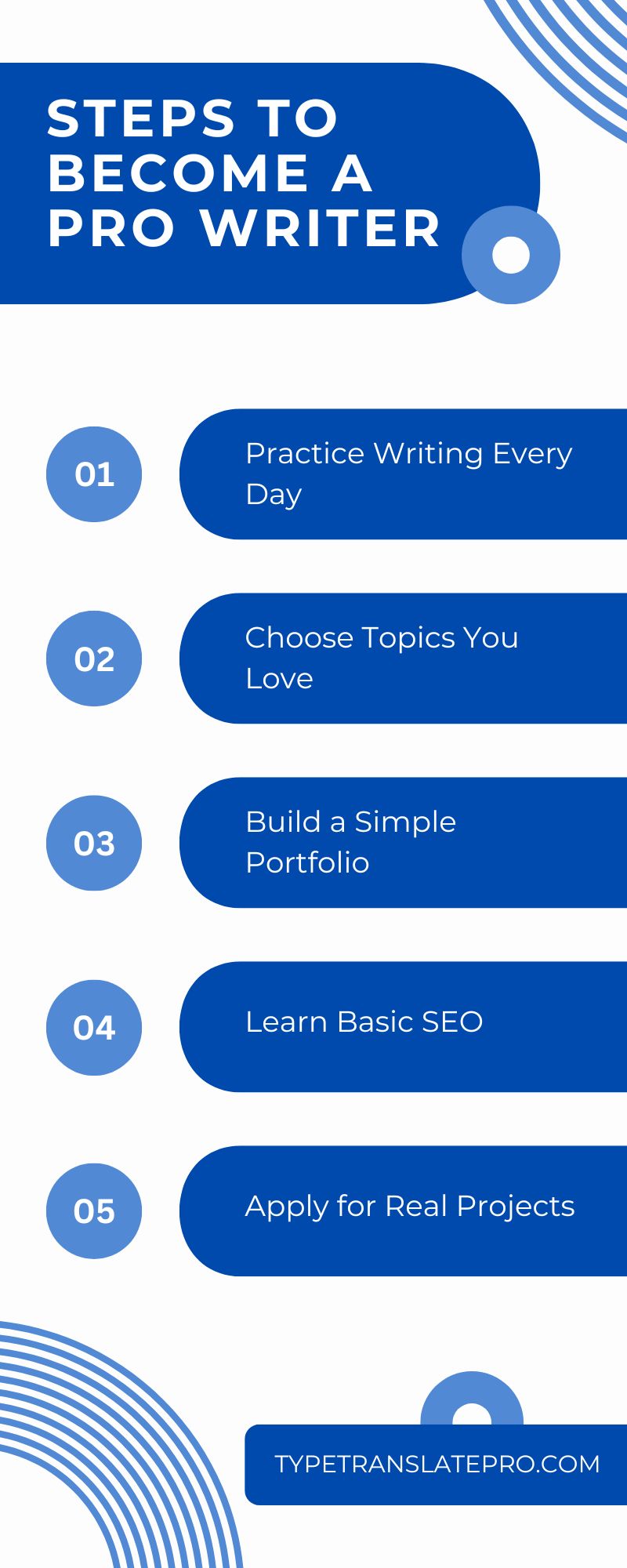
Here are 5 simple steps to become a content writer from scratch. Even if nobody knows your name yet, follow these steps, and you can quickly create your mark. Today, you may be “just starting out”, but soon you will become an “in-demand writer.”
1. Practice Writing Every Day
First things first. Develop the habit of writing. Start by writing something daily. It can be a short story, a blog post, a social media post or even a review of your favorite snack.
Heard of writer’s block? The more you write, the better you get. Even if nobody reads what you are writing, you are building skill and confidence. plus, a portfolio to showcase your skills.
Most successful writers started by practicing in private before approaching the clients.
2. Choose Topics You Love
In your initial days, pick subjects you are truly interested in. For example, sports, fashion, technology, food, travel, etc. When you care about the topic, your writing sounds real and fun.
Sometimes, when you post it on your LinkedIn or Facebook, readers and companies can feel your passion. Soon, you will see engagements in your post, and that’s how they remember you.
Start with one topic, master it and may be you can try 2-3 more niches.
Niche expertise is very important to grow as a writer, but when you are a beginner, you will be asked to write on any topic.
3. Build a Simple Portfolio
Collating all your creative stuff, making it presentable, in order to attract clients, is the only purpose of creating a portfolio.
Collect your best 3-5 articles in one place—a free blog, Google Drive, or a portfolio site like Clippings.me. Have shared some of the best and DIY platforms later in this article.
Your portfolio shows future clients what you can do. You do not need to be an expert; just demonstrate clear writing and original thinking as sometimes, the only requirement of a client is a fresh face or perspective.
4. Learn Basic SEO & Social Media Engagement Rules
When you are creating content for social media, your posts should attract likes and comments. For blog posts, getting search engine traffic is a must.
On YouTube, you can learn about how to get social media attention, how to use keywords, headings, and meta descriptions so your articles can be found online.
There are free courses everywhere. Knowing just basic SEO gives you an advantage over other beginners and makes your writing more valuable.
I will also suggest you to try basic tools like Grammarly, Surfer SEO, Semrush, etc that will give an extra edge to your content.
5. Apply for Real Projects
Now that you are writing for some time, already have a portfolio in hand, you are all set to hunt for your first client.
Find jobs on websites like Upwork, Fiverr, or ProBlogger. Start small—apply even if you do not have experience. Every project teaches you something new and helps you grow your network.
Many top professionals, in fact, all of us, got our first gig by simply applying with a positive attitude and a few samples.
My suggestion here is, don't run behind money. Look for quality tasks where you can build long-term relationships and a practical learning opportunity, of course. Money will automatically come your way after a few months.
Why Worried About Education Qualification?
A common question from candidates is: “Do I need a degree to become a content writer?” The short answer is: while a Bachelor’s in English, Communications, or Journalism can help, it’s not mandatory.
If your command of English is not good, you can use tools like Grammarly. The good thing is that we have an exclusive 30% Grammarly discount that is available on all payment options, like monthly, quarterly and annually.
You do not need a fancy degree to become a content writer. What matters is how well you can write and share ideas.
You know what! I once hired a writer who proudly said, “My only certificate is a list of content already ranking on Google.” Do I need more? NO.
She did a fantastic job for us!
Simple Truth: Customers and companies care about your writing, not your certificates. They want to see your skills, not your grades. I remember one funny incident – In my initial articles for a client, topic was about making a cup of Green Tea. I messed up and wrote, “boil the water after you drink your tea.” The client laughed and said, “Next time, I’ll do it backwards!” So, everyone makes mistakes.
Certifications and Courses Helpful For Writers
I don’t know who you are and what is your current qualification, I would first of all encourage you to start. Later on, when you will grow in the field, you can add certifications and courses to boost your knowledge and credibility.
Here is a quick list of my recommended courses.
| Pathway | Recommended For | Advantage |
|---|---|---|
| Bachelor’s in English/Journ. | Beginners, career writers | Strong foundation in writing, research |
| Certifications (SEO/Content Writing) | Those who want specialization | Industry-recognized proof of skills |
| Self-study + Practice | Anyone | Builds real portfolio; free or low-cost |
| Digital Marketing Courses | Aspiring digital marketers/brand strategists | Broader online marketing knowledge |
| No formal education | Switchers, freelancers | Portfolio > degree in real-world context |
Example: One of our language translation students recently got his start with no degree. He started landing gigs by showcasing strong samples on Fiverr.
Personal advice: Focus on skill mastery and results. For many clients I’ve worked with, a great portfolio and attitude outweigh formal certificates.
Types of Fields for Content Writers
Content writers work everywhere. First thing is the place where you write, and the second one is the type of content.
You can write for blogs, companies, social media, schools, or even games like Minecraft. Now, you might write about any of the niches, viz., cars, food, pets, or technology.
You never know what will make you famous tomorrow. My friend started writing stories about her pet turtle. Soon, a pet shop asked her to write for their website. Now, she is a “turtle expert“.
Easy Tip: Pick topics you enjoy. When you like the topic, the words will flow, and you will be able to add value as well.
Content writing is not limited to blogs or news articles—today, virtually every company needs content. Here’s a breakdown of thriving fields in 2025:
| Field/Role | Typical Projects | Avg. Pay (per hour) |
|---|---|---|
| SEO Content Writer | Articles, landing pages | $25+ |
| Technical Writer | Manuals, product docs, guides | $30+ |
| Social Media Content Writer | Posts, campaigns, brand stories | $25+ |
| Ghostwriter | Books, thought leadership, blog posts | $40+ |
| Copywriter | Sales pages, email campaigns, adverts | $35+ |
| Academic/Research Writer | Papers, study guides, grant proposals | $30+ |
| Scriptwriter | Video scripts, podcasts, webinars | $30+ |
Example: A recent client hired a content writer for their SaaS startup to create Online onboarding manuals—a niche not traditionally associated with creative writing but vital for product success.
Niche Expertise and Pay Rate
As a beginner, I suggest everyone that no business is small. Work happily on each new project you are awarded by the client. Lateron, may be after a year, I suggest you to estabhlish youself as Expert of one niche or field.
First of all, from the fields above, pick your field, like you want to become a Social media content writer or Seo content writer. Choose one field as your primary expertise.
Secondly, if you are interested in Seo content writing, pick a niche, like Healthcare or Travel. Writers writing on every niche are generally not considered as experts and this impacts pay rate.
We have several courses, where we teach language, translations and content creation.
When working with corporations, the best placements came to writers who could specialize (e.g., health tech blogs, e-commerce SEO copy), proving that knowledge depth in a niche leads to best industry rates and also, quicker selection.
Now, that you know types of content writing streams, it is the perfect time to learn about some renowned platforms to get your first client.
Platforms to Get Content Writing Business
Finding consistent work is about being visible where companies and recruiters seek talent. For your help, I have shared the list of popular platforms, I personally used, along with commission rates you need to pay (hope this helps as you know the cut in advance :) )
Some of the best and highest-paying platforms for writers in 2025 are:
| Platform | Best for | Fees/Payment Structure | Extra Notes |
|---|---|---|---|
| Upwork | General, long-term | 10% commission | Requires portfolio |
| Freelancer | One-off, diverse gigs | Sliding scale commission | Paid memberships available |
| Fiverr | Quick gigs, custom work | 20% commission | Fast client turnover |
| Compose.ly | Regular, high-quality | $0.10–$0.14/word; no membership | Writing test required |
| Scripted | Niche expertise, blogs | Project-based | High-paying |
| FlexJobs | Remote full/part-time | Subscription ($25/month) | Curated, less competition |
| ProBlogger | Blogging, guest posts | Free; pay per listing | Niche opportunities |
There are many other platforms in the market, but the list above should be sufficient for you to start. Many freelancers I mentored got their first client from a combination of paid (FlexJobs) and free (ProBlogger) job boards. Once you get the client, it is easy for you to quickly scaling income through recurring clients.
Now the Action Tip. Create a profile on any of the above mentioned platform. Apply for five jobs everyday. Do not worry if you do not get business in initial days. Everyone gets "No" before a big "Yes".
When you will create account on above platforms, you will get client queries for sure. The next step will be sharing the portfolio, your existing work done for the cleint. Let’s discuss that now.
Where to Create Your Portfolio
A professional writing portfolio is not optional; it’s the only way to win trust and secure well-paying gigs. A portfolio is a collection of your writing. It shows clients what you can do. You can use below mentioned platforms, making it simple for you to create and share.
Mandatory Tip: Write atleast one new article for your portfolio every week, even if nobody asks you.
Here’s where to start:
| Platform | Features | Use Case | Cost |
|---|---|---|---|
| Contently | Clean, professional, easy links | All writers | Free |
| Clippings.me | Customizable, visual | Freelancers | Free+ |
| JournoPortfolio | Extensive customization | Advanced writers | Paid |
| Muckrack | Best for journalists | Journalism-focused | Free |
| Built-in audience, easy share | Career progression | Free |
Our one successful course graduate built a Contently portfolio with five self-published pieces and was hired for a multinational project—proof that initial samples and solid presentation matter most.
Recommended Skills for Writers
While it is all ok to start without any professional course or skillset, to grow and get a higher paying rate, it is a must to acquire some or all the below mentioned skills.
Basis my own experience, several soft and technical skills set the best content writers apart in 2025. Some of them, Iam still mastering at the age of 65, so you definitely can:
| Skill | Why It’s Vital |
|---|---|
| Research/Fact-Checking | Ensures accuracy, credibility |
| Growth Mindset | Adapts to feedback, market needs |
| Storytelling | Engages, converts readers |
| Basic SEO | Increases content visibility |
| AI Content Tools | Efficiency, modern relevance |
| Communication/Collaboration | Work with clients, teams |
| Time Management | Meet deadlines, multi-projects |
| Adaptability | Write for various platforms |
One corporate client sought specifically a writer who knows the basic working of AI tools for content outlines, demonstrating how technical knowledge is becoming non-negotiable.
A top-rated writer I coached didn’t have the best grammar skills initially. He excelled because of advanced research and client communication skills, allowing him to eventually get recurring projects. He kept on investing in upskilling as per the changing scenarios. All this improves your pay rate.
Frequently Asked Questions (FAQs)
Can I Become a Content Writer Without Any Experience?
Yes. Start by self-publishing articles, practicing consistently, and building a solid portfolio. Many platforms accept new writers as long as they can show potential and skill through samples.
Do Content Writers Need to Know SEO in 2025?
Absolutely. Basic SEO knowledge—such as keyword placement, meta tags, and understanding Google algorithms—is essential for standing out and delivering value to employers and your clients.
What Are the Most Profitable Writing Niches Right Now?
In 2025, niches like technology (AI, SaaS), healthcare, finance, and e-commerce consistently pay above $25 per hour for skilled content writers.
How to Set Rates as a Beginner?
Research current pay rates within your chosen niche and platform. For starters, $0.05–$0.10 per word is average, but experienced writers charge significantly more. If you are a beginner, don’t run behind money, target learnings and relationships.
Do I Need Certifications to Get Good Work?
Certifications can boost credibility but are not a must-have. Portfolio quality, testimonials, and real results carry more weight in hiring decisions.
Conclusion: My Own Experience Of Becoming A Content Writer At Age 60+
Becoming a successful content writer in 2025 is more practical and attainable than ever—provided one focuses on growing relevant skills, building a compelling portfolio, and leveraging the platforms where clients actively search for talent.
I will now share some takeaways from my experience. As someone who has guided hundreds of candidates and seen hiring up close, the most successful writers are those who:
- Are consistent and positive in their approach.
- Decide to start. Prioritize real-world projects over endless “learning loops.”
- Are good at networking and following up.
- Don’t wait for perfection; they happily learn on the job.
Invest time to research trends, master both language and digital tools, and showcase personality in your writing. Remember, every big writer once started out with a simple, well-crafted sample article and determination to grow.

About the Author:
Hi All, This is Renu. A Bsc. B.Ed. ex principal with over 45 years of experience. I have worked for renowned government school in India. During my tenure, I have helped in NCERT syllabus updations, written several books in english English literature.
Post my retirement, I have been teaching English Language, translations and content creations to the students across the world. Have created several typing, content writing and translation related courses on this website.
Not very active on social media but you can connect me on LinkedIn.